
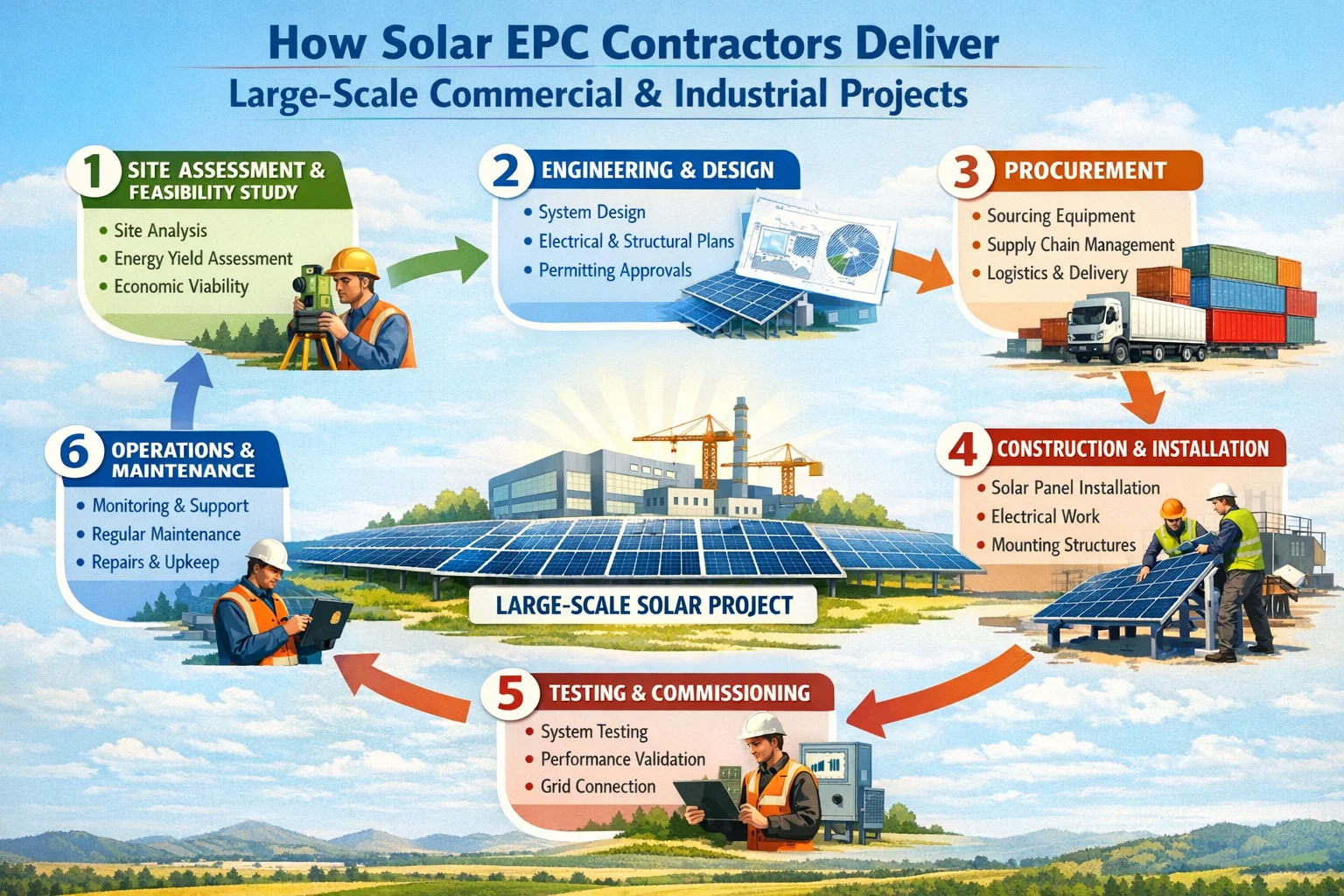
With more commercial and industrial industries moving to renewable energy, solar projects have become widespread in the state of Arizona. These undertakings must be meticulously planned, engineered and synchronously executed. Solar EPC contractors are very important here. Companies in the city of Phoenix that have a reliable solar EPC would be assured that the solar systems would be designed and provided efficiently to completion.
What Is a Solar EPC Contractor?
EPC is an abbreviation of Engineering, Procurement, and Construction. A solar EPC contractor is in charge of the entire life cycle of the solar project, starting with the initial design to the final system commissioning. Businesses do not need to deal with numerous vendors and can leave all the technical and operational opportunities to one team.
In commercial and industrial solar applications, this method can simplify the processes of communication and minimize the chances of delays or discrepancies.
Key Phases of EPC Solar Projects
The installation of large-scale solar arrangements is usually conducted in a systematic way to achieve performance, safety and compliance.
System Design and Engineering
The first step is site evaluation, energy consumption analysis, and system design that will address the operational requirements. This involves layout planning, structure and electrical design.
The right engineering will make sure that the solar system will be efficient in energy production and it will fit with the infrastructure of the property.
Procurement of Equipment
After design, the EPC contractor procures the required components. This consists of solar panels, inverters, racking systems and electrical equipment. The choice of equipment depends on the needs of the system, its serviceability and its compatibility with the design as a whole.
Construction and Installation
The construction stage involves the installation of solar panels, mounting systems and electrical connections. In the case of commercial projects, it can include rooftop systems, ground-mounted arrays, or solar carports.
The EPC contractors who have experience in the field manage installation teams so that work is done safely and in line with design specifications.
Electrical Integration and Commissioning
Once installed, the system becomes a part of the electrical infrastructure of the building. Testing and commissioning are done to ensure the system is working properly and it is performing to expectations.
This is a stage that will make the system operational.
Why the EPC Approach Is Important for Commercial Projects
Solar systems on a large scale entail a variety of technical elements and legal demands. The EPC model makes the project execution easier by offering:
- One point of responsibility.
- Coordinated project management
- Consistent quality control
- Efficient timelines
This organized method lowers the complexity and enhances the reliability of the project to businesses that invest in solar.
Applications in Commercial and Industrial Settings
Solar EPC contractors normally work in different fields, such as:
- Distribution centers and warehouses.
- Manufacturing facilities
- Office complexes
- Retail properties
- Industrial operations
Such undertakings usually need a tailored system design and sophisticated electrical integration to achieve increased energy demands.
Long-Term Performance and Maintenance
Commercial solar systems need some monitoring and maintenance after installation to have a consistent performance. The service providers or EPC contractors might assist in the inspection, troubleshooting and repairs of the system where necessary.
Periodical maintenance can be used to increase the life span of the systems and sustain energy output.
Conclusion
Solar EPC contractors are crucial in the provision of commercial and industrial-scale solar projects by taking care of all the operations including the design and commissioning processes. Their organized methodology assists in ensuring that systems are well engineered, installed and integrated to achieve long term performance. Companies collaborating with established EPC companies are in a better position to handle the complexity of projects and to deliver credible energy results.
